It's 2026. Part Two
The Leadership Capabilities Each SRL Stage Demands
If you haven't already read part one of this series, check back to the BLOG and give it a glance.
The critical insight behind SRL is that leadership itself must evolve as readiness evolves.
The behaviors that make progress possible at one stage actively block progress at the next. This is why so many initiatives stall: leaders keep applying yesterday’s strengths to today’s “yes, buts”.
The NEPTUNE model allows leaders to see – in advance – what kind of leadership the system is asking for next.
What follows is not a checklist, but a diagnostic lens.
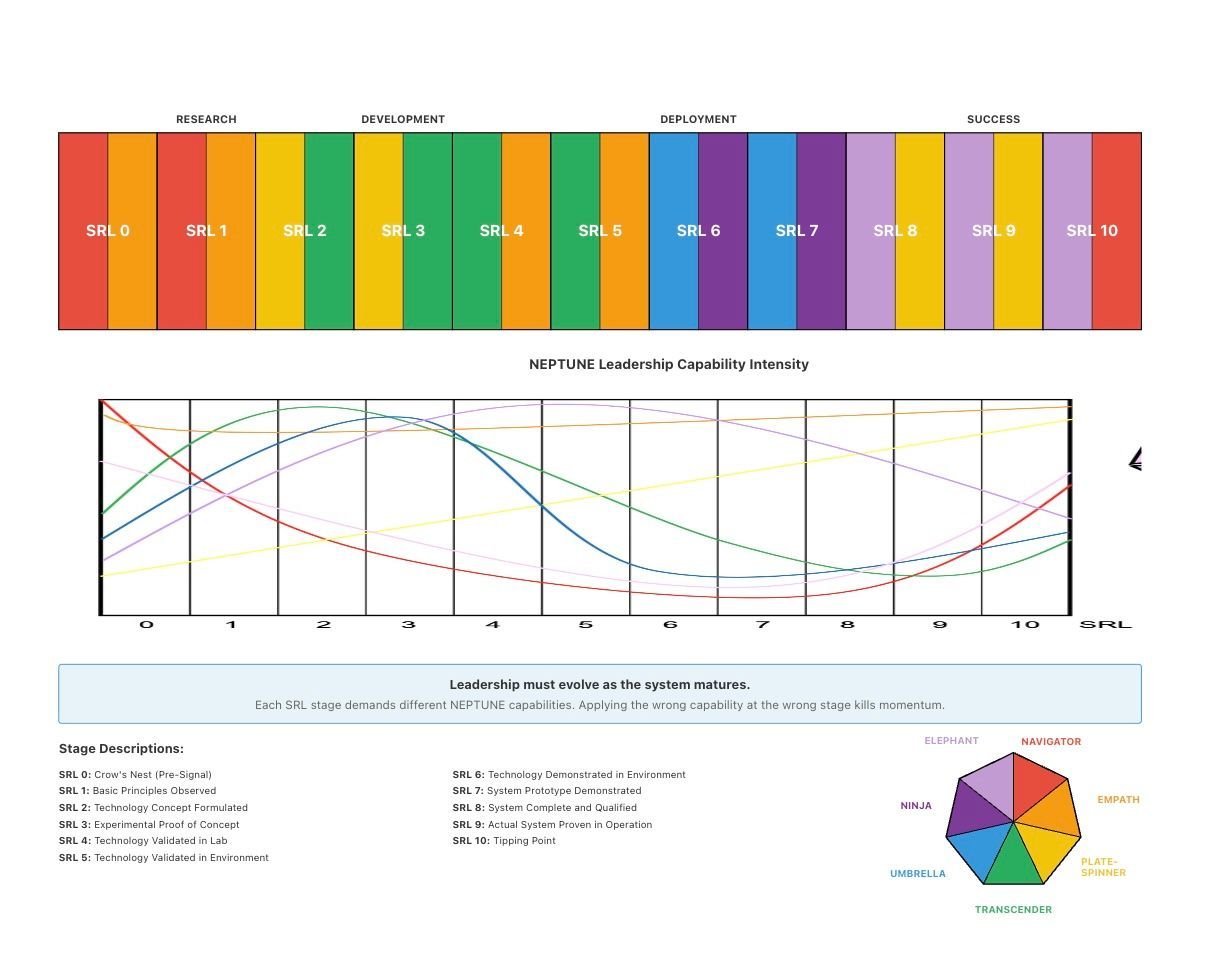
SRL 0–1: Signal to Hypothesis
Dominant NEPTUNE: Navigator, Empath
At the earliest stages, nothing is proven. There is no business case, only weak signals, anomalies, frustrations, and unmet needs.
The core “yes, but” here is:
Yes, this feels important… but we don’t yet know what it is.
- Navigator capability is essential to sense direction without data
- Empath capability of empathising with customer/consumer unspoken needs is critical to avoid solving the wrong problem
This is where organizations most often kill opportunities prematurely, because they demand certainty before direction.
SRL 2–3: Concept to Proof of Possibility
Dominant NEPTUNE: Plate-Spinner, Transcender
Here the question becomes:
Yes, it sounds good… but can it actually work?
Multiple experiments run in parallel. Fragility is high. Failure is information.
- Plate-Spinner leaders keep multiple options alive without forcing premature convergence
- Transcender leaders reframe contradictions rather than trade them off
This is where incremental thinkers often over-optimise a weak idea instead of allowing a stronger one to emerge.
SRL 4–5: Prototype to System Fit
Dominant NEPTUNE: Transcender, Empath
The system now says:
Yes, it works… but does it fit the real world?
This is where second-order effects appear , organisational resistance, user friction, ethical concerns, unintended consequences.
- Transcender capability resolves conflicts between technical success and human reality
- Empath capability ensures adoption rather than mere functionality
Many “successful” innovations die here because leaders confuse working with belonging.
SRL 6–7: Pilot to Organizational Commitment
Dominant NEPTUNE: Umbrella, Ninja
Now the challenge is political, not technical:
Yes, it works and fits… but it threatens something important.
Legacy systems, incentives, power structures, and careers come into play.
- Umbrella leaders provide protection, legitimacy, and air cover
- Ninja leaders remove obstacles decisively and without theatre
This is where most large organisations lose nerve. And where external 1%ers are often decisive.
SRL 8–9: Launch to Operational Reality
Dominant NEPTUNE: Elephant, Plate-Spinner
The system now asks:
Yes, it’s launched… but can it survive contact with reality?
Scaling introduces new fragilities: reliability, supply chains, regulation, reputation.
- Elephant capability integrates, stabilizes, standardizes, and embeds
- Plate-Spinner capability keeps adaptation alive during growth and ensures the myriad tasks needing to be done are done on time, on budget and on specification
Many organisations mistake launch for success. It is not.
SRL 10: Tipping Point to Enduring Success
Dominant NEPTUNE: Elephant, Navigator
At tipping point, the question shifts one final time:
Yes, this is successful… but what does it now enable – or endanger?
This is where moral, social, and systemic implications crystallize.
- Elephant leadership ensures durability and legitimacy
- Navigator leadership looks beyond the current S-curve to the next and keeps a look-out for a need for appropriate ‘Plan B’ pivots
True getting new things done leadership does not stop at success, it anticipates what success will break.
Here’s how the relative importance of the seven NEPTUNE elements will shift over the course of a typical SRL0-10 journey. Note that at no stage does the need for any single element drop to zero: getting new things done demands the continual presence of a viable system and the seven NEPTUNE elements define viability.
The Final Leadership Insight
The SRL journey is not a test of intelligence.
It is a test of situational leadership maturity.
Most leaders are excellent at some of these stages.
Very few are excellent at all of them.
That is why NEPTUNE is best used first as a diagnostic:
- To understand which capabilities you already have
- To anticipate which “yes, buts” will soon appear
- To decide whether you need to develop, re-balance, or bring in missing leadership capacity
Before you try to get new things done, know what kind of leadership the system will demand next.
That is how 1%ers think.
That is how tipping points are reached.
That is how signals become scale.
RITE Advisory Compass